The Great Solar Debate: Should You Choose TOPCon or Mono PERC?
If you have asked two or three solar installers for quotes, you have almost certainly heard conflicting advice. One installer says: "Take Mono PERC, it is time-tested and saves you money upfront." Another installer says: "Mono PERC is yesterday's technology; you must take N-Type TOPCon for the best generation."
As a homeowner investing ₹1.5 to ₹2.5 lakh into a 25-year rooftop asset, how do you decide who is telling the truth? Let's break down both technologies in simple, straightforward language without overwhelming you with physics jargon.
What Is the Fundamental Difference Between the Two?
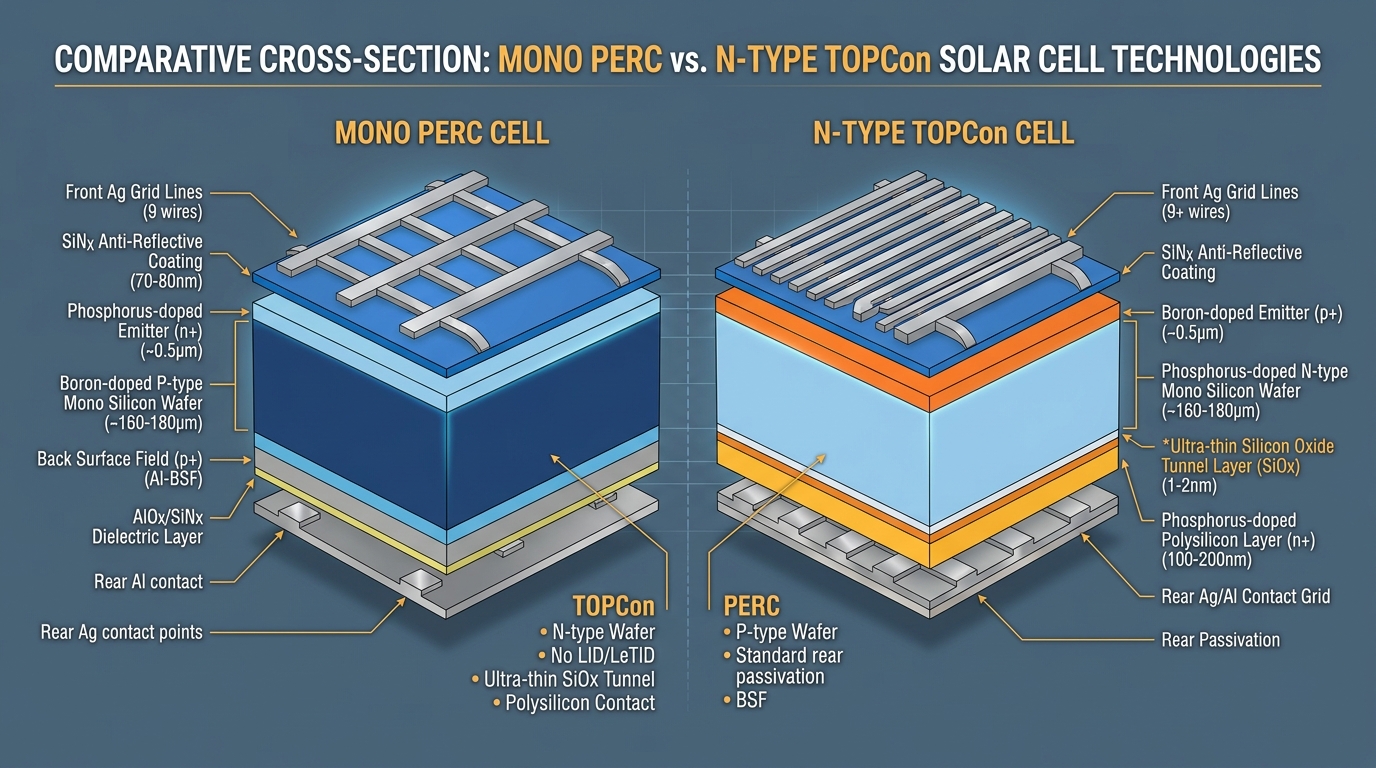
At the most basic level, the difference comes down to the type of silicon wafer used inside the cell:
- Mono PERC uses "P-Type" Silicon: The silicon is treated with Boron. When exposed to sunlight during the first few days of operation, trace oxygen bonds with Boron, causing an immediate 1.5% to 2% permanent power drop known as Light-Induced Degradation (LID).
- TOPCon uses "N-Type" Silicon: The silicon is treated with Phosphorus. Because Phosphorus does not bond with oxygen, TOPCon experiences virtually zero LID. It starts strong and stays strong.
The Heat Test: How Both Panels Perform at 45°C
If you live in Northern, Western, or Central India (such as Delhi, Rajasthan, Gujarat, Haryana, Madhya Pradesh, or UP), summer temperatures routinely push past 42°C to 46°C. When ambient air is 45°C, dark solar panels baking on your concrete terrace easily heat up to 65°C to 68°C.
Here is how each panel responds to extreme heat:
- Mono PERC: Power drops by ~0.36% to 0.38% for every degree above 25°C. At 65°C, your panel is running 14.4% below its laboratory rated capacity.
- TOPCon: Power drops by only ~0.30% per degree. At 65°C, the panel loses only 12%. That means on the hottest days of the year—when your household air conditioners are running at full blast—TOPCon produces 5% to 8% more usable electricity every single day!
25-Year Degradation: How Much Electricity Will You Get in Year 25?
All solar panels slowly lose a tiny fraction of their power each year. But TOPCon degrades significantly slower than Mono PERC:
- Year 1 Degradation: Mono PERC loses ~2.0% in its first year. TOPCon loses only ≤1.0%.
- Annual Degradation (Years 2 to 25): Mono PERC loses ~0.55% per year. TOPCon loses only ~0.40% per year.
- Power Remaining in Year 25: At the end of 25 years, a standard Mono PERC panel retains ~84.8% of its original power. A TOPCon panel guarantees at least 87.4% to 89% power retention.
Over a 25-year lifetime, that 4% to 5% higher retention translates into thousands of additional free kilowatt-hours delivered to your home.
The Price Difference: Is TOPCon Really More Expensive?
Two years ago, TOPCon was a premium luxury technology costing 15% to 20% more than Mono PERC. But in 2025 and 2026, massive factory expansions by Indian manufacturers like Tata Power Solar, Adani Solar, and Waaree have driven prices down dramatically.
Today, the benchmark price difference between DCR Mono PERC and DCR TOPCon is only ₹1.50 to ₹2.00 per watt:
- On a standard 3.3 kW system (6 panels of 550W), the total extra cost for TOPCon is only about ₹5,000 to ₹6,600.
- Because TOPCon generates 5% to 8% more units per day, it delivers roughly 18 to 25 extra electricity units every month.
- At an average grid electricity tariff of ₹7.50 per unit, those extra units save you an additional ₹1,800 to ₹2,500 per year.
- Payback: The extra ₹5,000 cost of TOPCon is fully recovered in less than 2.5 years. For the remaining 22+ years, all extra generation is pure financial bonus!
Side-by-Side Summary Table
| Parameter | Mono PERC (P-Type) | TOPCon (N-Type) |
|---|---|---|
| Panel Efficiency | 20.5% – 21.5% | 22.0% – 24.5% |
| Temperature Coefficient | -0.36%/°C (Moderate) | -0.30%/°C (Superior) |
| First Year Degradation | ~2.0% | ≤ 1.0% |
| Year 25 Power Output | ~84.8% | ~87.4% to 89.0% |
| Cloudy / Low Light Yield | Standard | 2% to 4% Higher |
| Cost per Watt (India DCR) | Baseline | +₹1.50 to +₹2.00 / watt |
The Final Verdict: Which Should You Choose?
Unless your installer is offering an unusually massive discount on Mono PERC panels, choose N-Type TOPCon. The minor ₹5,000 to ₹7,000 price difference on a 3kW installation is easily justified by the higher summer generation, zero light-induced degradation, and superior 25-year lifespan.