Why Are Modern Solar Panels Labeled 440W, 540W, or 550W?
When you speak to different solar contractors, you will hear numbers like: "Sir, we will install 440W panels" or "Sir, we recommend 550W mono half-cut plates." What do these numbers mean, and why should a homeowner care?
The "W" stands for Watt-Peak (Wp). It simply measures how much maximum electricity a single plate can generate at noon on a clear day. Five years ago, standard solar plates were only 300W or 330W. Today, advances in silicon manufacturing have created panels rated at 540W, 550W, and even 580W.
Why does this matter for your home? Because higher wattage per plate means you need fewer total panels on your roof to achieve your target capacity:
- With older 330W panels: You needed 10 large panels to reach 3.3 kW.
- With modern 550W panels: You need only 6 panels to reach 3.3 kW!
Fewer panels means fewer mounting rails, fewer holes drilled into your terrace waterproofing, faster installation, and more open terrace space left over for your family to enjoy.
What Is "Half-Cut" Technology? (The Highway Analogy)
In traditional solar panels, each solar cell was a single full square (usually 6 inches by 6 inches). In a modern Half-Cut panel, high-precision laser cutters slice each silicon cell into two equal halves. Instead of having 60 or 72 full cells, the panel has 120 or 144 half-cells.
Why do manufacturers cut the cells in half? The answer comes down to electrical resistance and heat:
1. Lower Electrical Loss and Heat
Think of electricity flowing through a wire like cars traveling down a road. If all cars are crammed onto a single-lane road, traffic slows down and friction creates heat. In electrical physics, whenever current flows through resistance, power is lost as heat. When you cut a solar cell in half, the electric current in each half-cell is cut by 50%. This drops the internal resistance losses by 75%! The panel runs significantly cooler and converts more of the sun's energy directly into usable electricity.
2. The Shade Survival Superpower
On an Indian terrace, shadows are a common reality—a neighbor's parapet wall, an overhead Sintex water tank, or a television antenna can cast a shadow across your panels. In an older full-cell panel, all cells were wired in one continuous loop. If a shadow fell on just the bottom 10% of the panel, the entire panel would stop generating electricity.
Half-cut panels are split into two completely independent halves (top and bottom) with separate bypass diodes. If the bottom half is shaded by a water tank, the top half continues to generate 100% of its electricity undisturbed. This feature alone increases annual power generation by 4% to 7% on typical urban terraces.
What Does "16BB" Mean? Why More Busbars Are Better
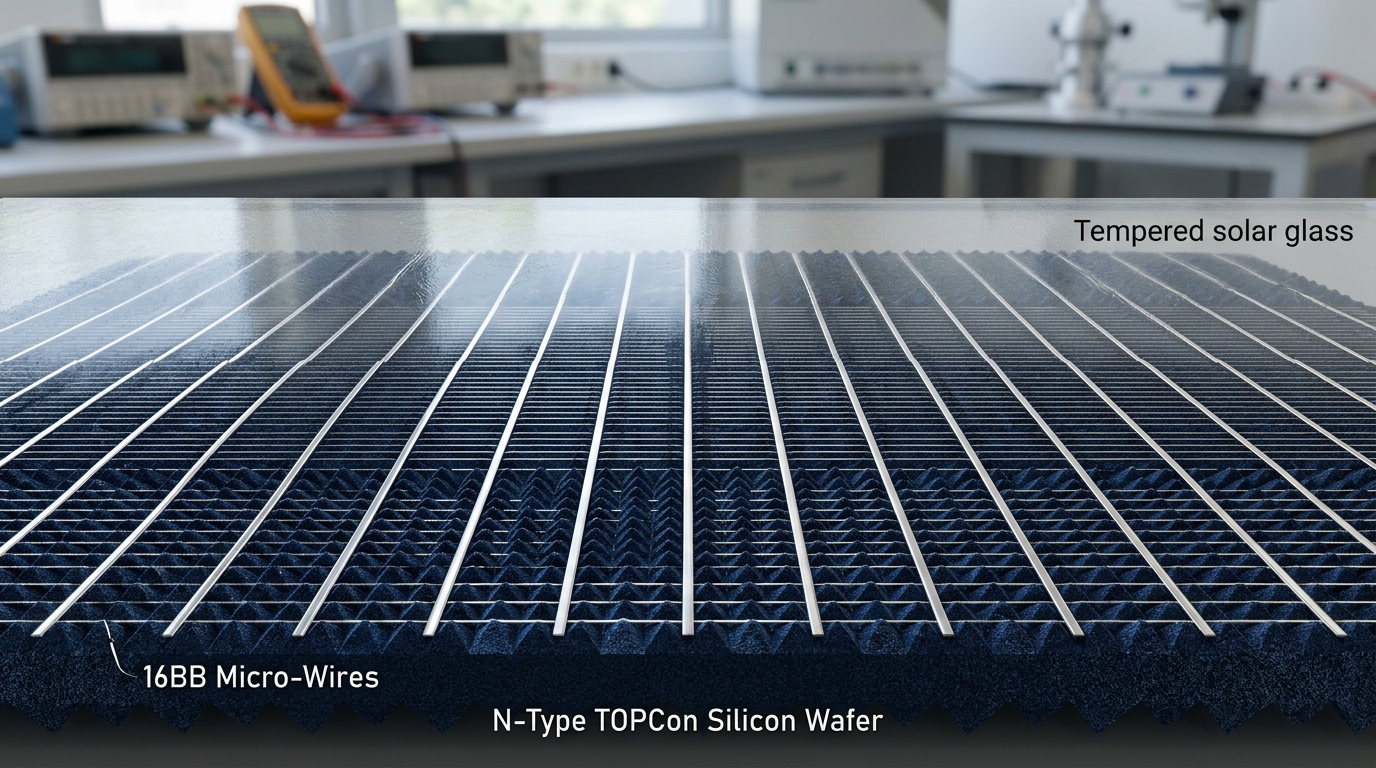
Look closely at the dark face of a modern solar plate. You will see thin silver metallic lines running across each cell. These lines are called Busbars (BB). Their job is to collect the electrons knocked loose by sunlight and carry them into the copper cables.
- Old Generation (5BB & 9BB): Panels used 5 or 9 thick, flat silver ribbons. These thick ribbons blocked sunlight from hitting the silicon underneath and caused internal stress.
- Modern Generation (16BB Multi-Busbar): Advanced panels use 16 ultra-thin, rounded micro-wires. Because the wires are rounded like tiny mirrors, incoming sunlight that hits the wire bounces onto the silicon instead of being blocked.
- Micro-Crack Protection: Over 25 years of hail, heavy storms, and temperature swings, silicon wafers develop tiny microscopic cracks. With 16 busbars, there are 16 separate highways for electricity to escape. Even if a cell develops a micro-crack, the current simply flows through neighboring busbars without creating a dead zone or a dangerous hot-spot fire hazard.
550Wp vs 440Wp: Which One Should You Pick?
Both 440Wp and 550Wp panels use modern half-cut technology. So which one is best for your specific roof?
| Feature | 440Wp Modules | 550Wp Modules |
|---|---|---|
| Physical Size | ~1.75m × 1.13m (Compact) | ~2.28m × 1.13m (Large) |
| Weight | ~21 kg per panel | ~28 to 32 kg per panel |
| Plates for 3.3 kW | 8 Plates | 6 Plates |
| Best Rooftop Type | Sloped roofs, tin sheds, narrow odd-shaped terraces | Flat RCC terraces, elevated gazebo structures |
| Installation Ease | Easy for 1 or 2 technicians to carry up stairs | Needs 2 to 3 workers to safely lift up spiral terrace stairs |
The Bottom Line: If you have a standard flat concrete (RCC) terrace, choose 540W to 550W TOPCon 16BB panels. You will need fewer panels, fewer mounting rails, and will achieve the cleanest aesthetic look on your roof.