The Dark Reality: Counterfeits in the Indian Solar Market
With the announcement of the PM Surya Ghar Muft Bijli Yojana (providing a direct subsidy of ₹78,000 for millions of homes), demand for rooftop solar in India has exploded. Unfortunately, this massive surge in demand has created a thriving grey market of counterfeit and sub-standard solar panels.
Unscrupulous local contractors often buy factory rejects (known in the trade as B-grade or C-grade panels) from large manufacturing plants at a 40% discount, print counterfeit stickers of famous brands like Tata Power Solar, Adani, or Waaree, and install them on unsuspecting homeowners' rooftops.
What Happens If You End Up with Fake or B-Grade Panels?
- You Permanently Lose Your ₹78,000 Subsidy: Government DISCOM officers inspect every installation before approving the net meter. They scan the internal serial numbers. If the numbers do not match official manufacturer databases, your subsidy is immediately blocked.
- Extreme Fire Hazards: B-grade panels often contain micro-cracked cells or poorly soldered busbars. Under high current, these defects turn into intense "hotspots" exceeding 150°C, which can crack the tempered glass or cause terrace electrical fires.
- Rapid Power Drop: While genuine Tier-1 panels guarantee 85%+ power after 25 years, cheap counterfeit panels often lose 30% to 50% of their generation within just 2 to 3 years.
The Ultimate Verification Weapon: The Laminated RFID Tag
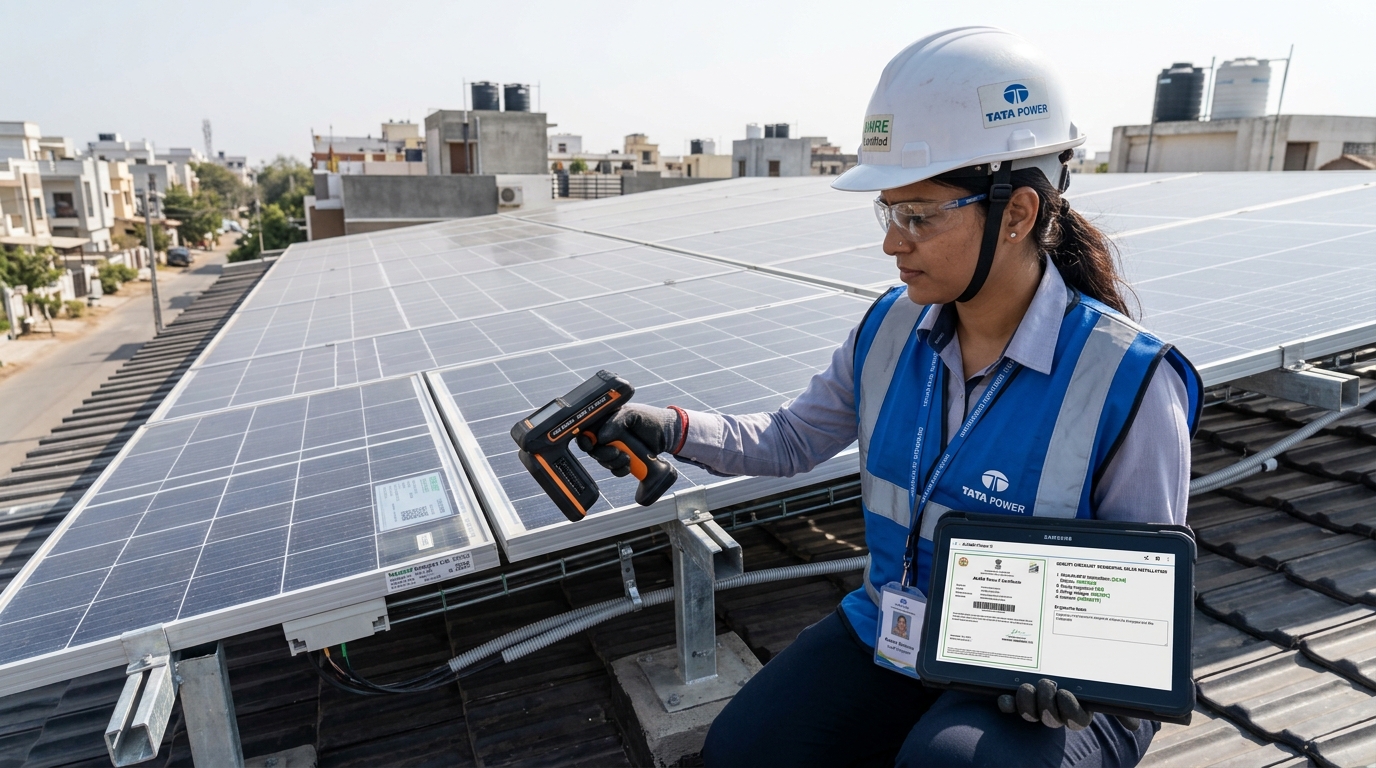
The Ministry of New and Renewable Energy (MNRE) foresaw this fraud and instituted a mandatory security measure: Every genuine solar plate sold in India MUST have a Radio Frequency Identification (RFID) tag laminated INSIDE the glass.
How to Check the RFID Tag Yourself:
- Walk up to the solar panel and look through the front glass in the top-left or bottom-right corner.
- You must see a small electronic chip (about the size of a postage stamp or SIM card) sealed beneath the toughened glass layer.
- Warning: If the installer points to a printed paper barcode sticker glued to the aluminum outer frame or backsheet, that is NOT the RFID chip! A fake sticker can be printed for ₹10 at any local print shop. The genuine RFID chip is physically baked inside the module during factory manufacturing.
When the DISCOM officer comes to commission your net meter, they carry an RFID reader wand. Placing the wand near the glass instantly reads the internal chip, which reveals: the exact factory name, the date and minute the panel was made, its tested wattage, and its unique national serial number.
How to Verify the BIS Registration Number on Your Phone
Under Indian law, all solar modules must be certified by the Bureau of Indian Standards (BIS) under the CRS (Compulsory Registration Scheme). Look at the technical label on the back of the panel. You must see the standard BIS "ISI" logo along with an 8-digit registration number formatted as R-XXXXXXXX.
You can verify this number in 30 seconds on your mobile phone:
- Visit the official government website: crsbis.in
- Enter the R-Number printed on your panel sticker.
- The portal will show the registered manufacturer's official company name, factory address, and validity status. If the company name does not match the brand on your panel, the label is a fake!
Step-by-Step Delivery Inspection: What to Check on Delivery Day
When the delivery truck arrives at your home with your solar panels, do not let the workers start drilling immediately. Spend 15 minutes doing this 4-step physical audit:
1. The Visual Cell Alignment Test
Look across the surface of the panels. In genuine Tier-1 panels, every half-cut cell is laser-straight, the gaps between cells are mathematically uniform (around 2mm), and there are no solder splatters or dark discoloration patches. In cheap B-grade rejects, you will see crooked cells, mismatched blue and black shades, and sloppy hand-soldering.
2. The Waterproof Junction Box & Cable Test
Turn the panel over and look at the black plastic junction box on the back. It must be marked IP68 (meaning it can be submerged in water without leaking). It should contain thick, black 4 sq.mm solar DC cables with genuine MC4 locking connectors. If the cables feel thin like ordinary home extension cords, reject the delivery.
3. The Aluminum Frame & Sealant Check
Examine the aluminum frame edges. Genuine panels use heavy-duty anodized aluminum with smooth 45-degree mitered joints sealed with clean industrial silicone. Counterfeit panels often use flimsy aluminum that bends under hand pressure and shows messy, smeared glue around the glass perimeter.
4. The Serial Number Match
Ensure that the serial number embedded inside the front glass matches the barcode label on the back frame, the delivery challan, and the manufacturer warranty card.