The Unsung Heroes of a 25-Year Solar Plant
When planning a rooftop solar installation, homeowners often spend 95% of their time researching panel brands and inverter models. But in electrical engineering, the panels and inverter are only half the system. The rest is known as the Balance of System (BOS) accessories.
Industry data shows that up to 70% of rooftop solar failures and fire incidents in India are NOT caused by defective panels—they are caused by cheap distribution boxes, substandard cables, and counterfeit connectors. Let's look at the essential accessories you must ensure your installer includes in your package.
1. The DC Distribution Box (DCDB)
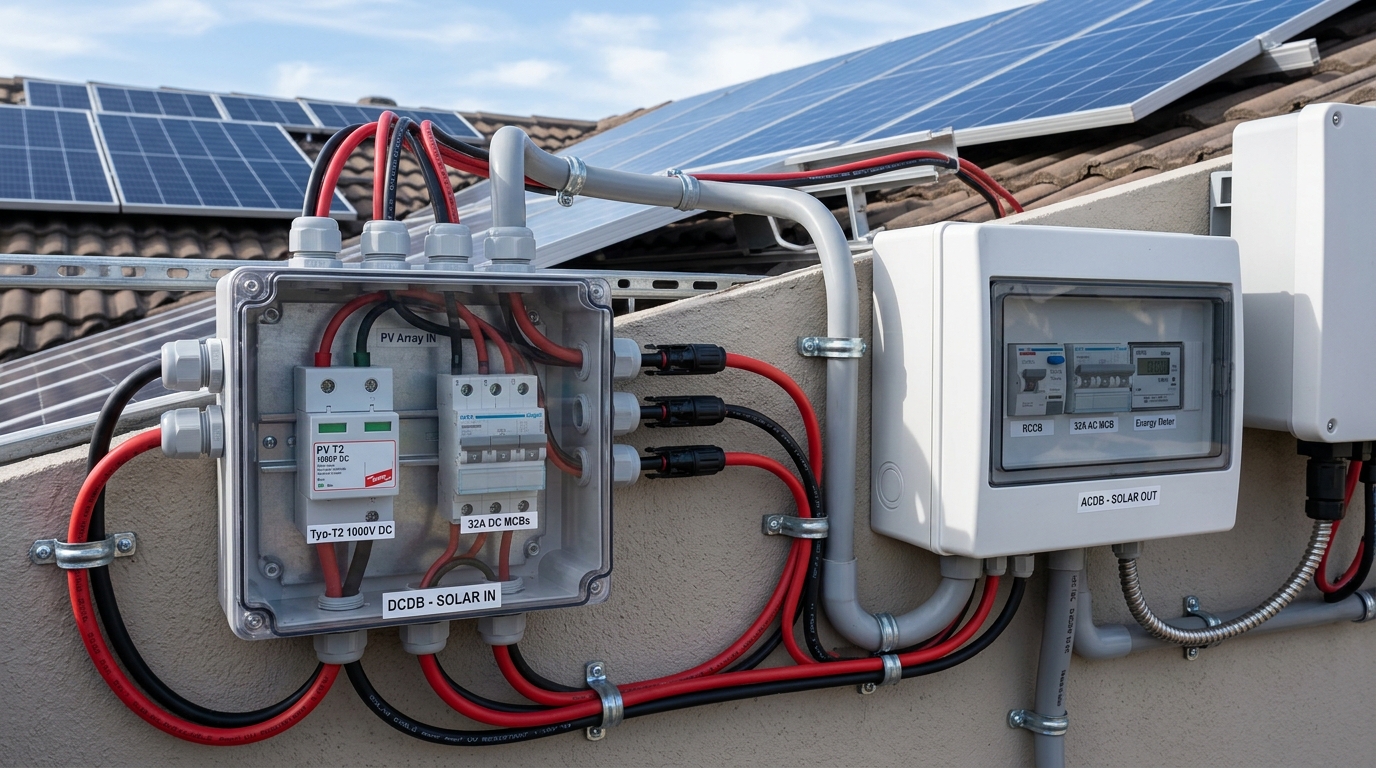
The DCDB is a weatherproof box installed on your terrace or near the inverter. It sits directly between the solar plates on your roof and the inverter input.
What is inside a quality DCDB?
- Type-II DC Surge Protection Device (SPD): When lightning strikes nearby (even a kilometer away), atmospheric electromagnetic pulses induce thousands of volts of dangerous static charge onto your rooftop solar panels. A Type-II SPD detects this voltage spike in nanoseconds and diverts the surge safely into the earthing pit before it can fry your expensive inverter.
- DC Miniature Circuit Breaker (MCB) or 1000V DC Fuses: Allows you or a technician to safely shut off the high-voltage electricity coming from the roof before performing any maintenance or cleaning.
Critical Warning: Never let an installer use an ordinary home AC switch in place of a proper DC MCB. Direct Current (DC) does not cross zero volts like alternating current does; if an ordinary AC switch is turned off under full solar load, it creates a persistent electrical flame (an arc) that will melt the box and cause a rooftop fire!
2. The AC Distribution Box (ACDB)
While the DCDB handles direct current from the panels, the ACDB handles alternating current coming out of the inverter on its way to your household appliances and the net meter.
What does the ACDB protect?
- Protects Your Inverter from Grid Spikes: If a local electricity transformer nearby sparks or surges, the ACDB's surge protector clamps the spike before it can damage your inverter's output board.
- Protects Your Home Appliances: Ensures that power flowing into your distribution board is cleanly synchronized with your home voltage.
- Isolation MCB: Gives you an emergency cutoff switch to disconnect the solar plant from your home's main electrical panel.
3. Solar DC Cables vs Ordinary House Wires
Ordinary household wires use PVC insulation designed to sit inside brick walls at mild room temperatures. If PVC wires are placed on an Indian terrace, intense ultraviolet (UV) sunlight and 50°C summer heat will cause the plastic to crack, dry out, and turn brittle within 2 to 3 years.
For rooftop solar, you must strictly insist on electron-beam cross-linked XLPO (Cross-linked Polyolefin) copper solar cables:
- Tested to international standard EN 50618.
- UV-resistant and flame-retardant with a 25-year outdoor weather endurance rating.
- Typically sized at 4 sq.mm or 6 sq.mm to minimize voltage drop over long cable runs from the roof to the inverter.
4. MC4 Connectors: The Tiny Part That Causes Big Fires
Solar panels are connected together using specialized push-and-click plugs called MC4 Connectors (Multi-Contact 4mm). Because a typical 3kW to 5kW string carries 8 to 12 Amperes of direct current at 300 to 500 Volts, loose or counterfeit connectors create high electrical resistance.
This resistance causes the plastic connector to heat up to 200°C, melt, and ignite dry terrace leaves or wires. Always verify that your installer uses genuine IP68 waterproof MC4 connectors crimped with professional ratcheting crimping tools, not ordinary pliers.
Homeowner's Accessory Checklist Before Signing Your Contract
- DCDB with genuine 1000V DC Type-II SPD (Brands: Citel, Dehn, Elmex, or Hensel).
- ACDB with 415V/230V AC SPD and Schneider / L&T / Havells MCB.
- 4 sq.mm or 6 sq.mm Dual-core UV-resistant XLPO Copper DC cable (Brands: Polycab, Havells, RR Kabel, or KEI).
- IP68 rated UV-resistant MC4 connectors.
- All rooftop cables housed inside rigid, UV-stabilized PVC or metal conduits with proper saddles (no dangling wires!).