What Exactly Is a "Solar Plate" and Why Does Your Choice Matter?
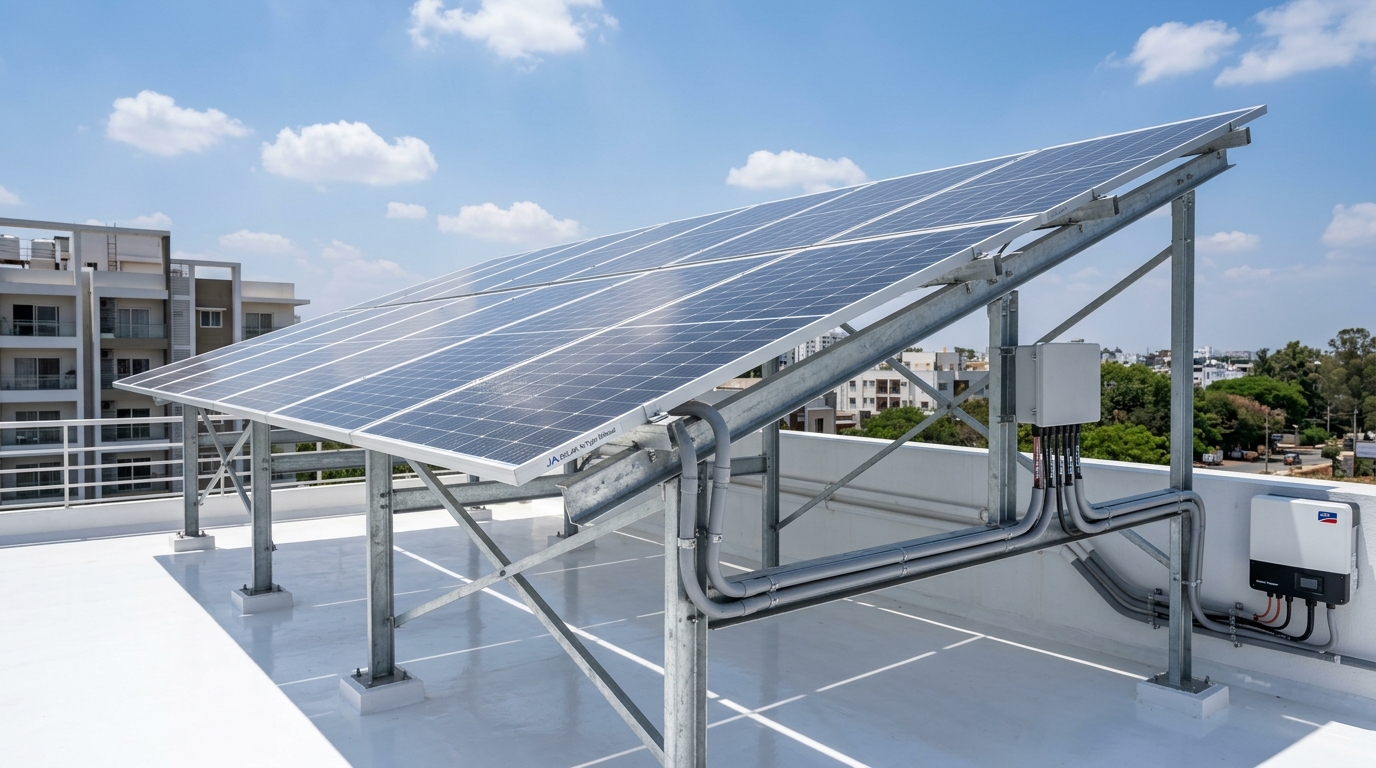
When people talk about installing solar on their house, they often say: "We want to put solar plates on our terrace." In the solar industry, a "solar plate" is officially known as a Solar Photovoltaic (PV) Module. It is made of dozens of thin silicon wafers joined together, covered by toughened glass, and framed in rust-proof aluminum.
From the ground, almost all solar panels look identical—they are large dark rectangles sitting under the sun. But inside that glass sandwich, the technology you choose will determine how much electricity your home produces every month, how well the panels survive scorching 45°C Indian summers, and whether the government will approve your ₹78,000 PM Surya Ghar subsidy.
The 3 Generations of Solar Plates: Which One Should You Buy?
Over the last ten years, solar panel technology has advanced rapidly. Today, you will encounter three main categories in the Indian market:
1. Polycrystalline Panels (The Outdated Blue Panels)
These are the older, bluish-colored panels you often see on streetlights or older agricultural pumps. They are made by melting silicon fragments together. While they were cheap five years ago, they are now completely obsolete for home rooftops. Their efficiency is low (only 15% to 17%), meaning you need a huge terrace to produce just 3 kW of electricity. Furthermore, they degrade very quickly in high summer temperatures. Verdict: Do not buy polycrystalline panels in 2025/2026.
2. Mono PERC Panels (The Reliable Standard)
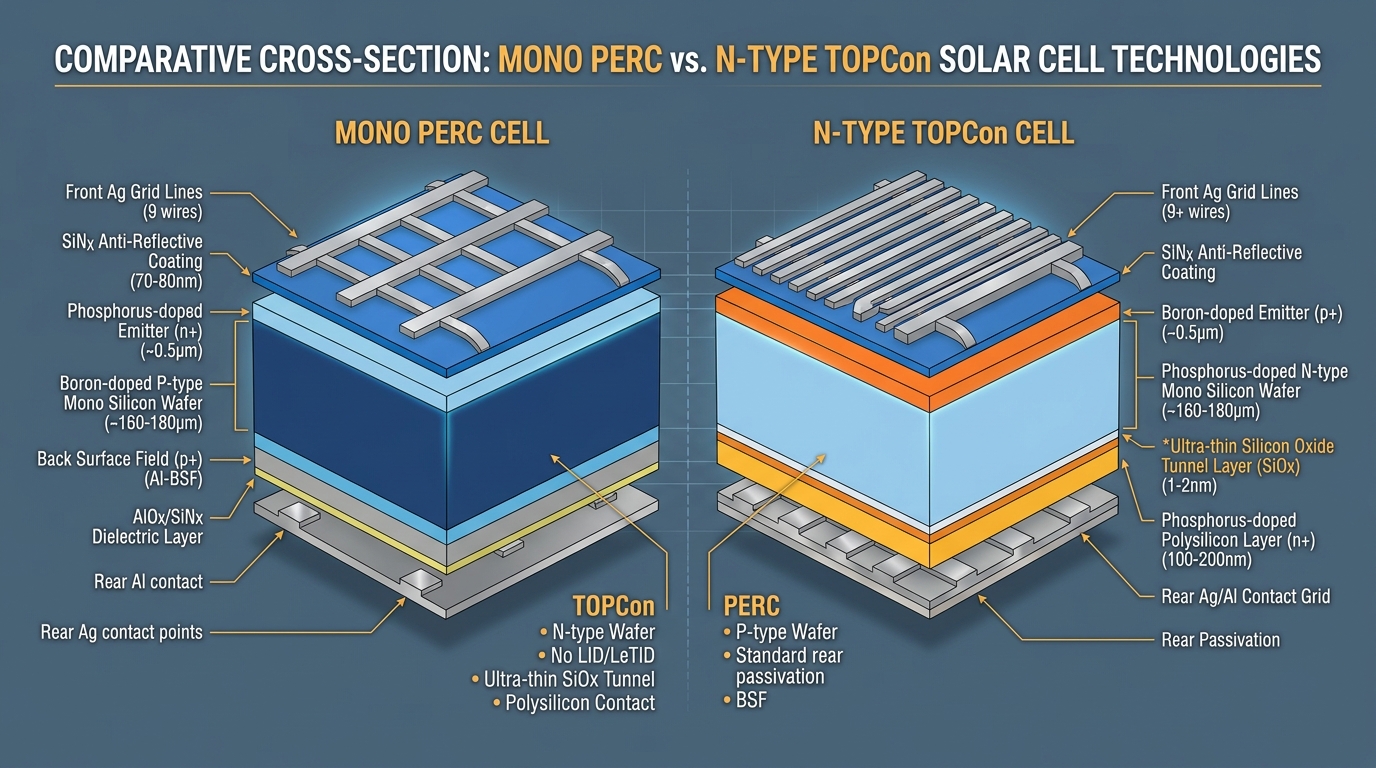
These are smooth, all-black panels made from single-crystal silicon wafers. Mono PERC (Passivated Emitter and Rear Cell) panels have been the workhorse of Indian rooftops from 2020 to 2023. They achieve efficiencies between 20% and 21.5%. They work well, but they suffer from one key weakness: when Indian summer temperatures reach 45°C, their electrical output drops noticeably.
3. N-Type TOPCon Panels (The Next-Generation Leader)
TOPCon stands for Tunnel Oxide Passivated Contact. It is an advanced N-Type silicon technology that represents the newest global gold standard. TOPCon panels reach efficiencies of 22% to 24.5% and generate significantly more units during hot summer months. Almost all top tier-1 Indian manufacturers—including Tata Power Solar, Adani Solar, Waaree Energies, and Vikram Solar—have shifted their production lines to TOPCon.
The Hot Summer Problem: Why TOPCon Wins in Indian Weather
A common misconception among homeowners is: "The hotter the sun, the more electricity my solar panels will make." In reality, the exact opposite is True! Just like your smartphone gets hot in summer and begins to lag or drain battery faster, solar panels lose electrical efficiency as they heat up.
Standard testing happens in laboratories at a cool 25°C. But on a sunny May afternoon in Delhi, Rajasthan, Gujarat, Uttar Pradesh, or Maharashtra, the surface of a dark solar panel can easily reach 60°C to 68°C. That is 40 degrees hotter than standard test conditions!
- Mono PERC Panels: Lose approximately 0.36% of their rated power for every 1°C increase above 25°C. At 65°C, a Mono PERC panel loses around 14% to 15% of its peak generation.
- N-Type TOPCon Panels: Feature a superior heat coefficient of ~0.30%/°C. Under the exact same 65°C heat, TOPCon loses far less power, delivering 5% to 8% more usable units of electricity every single day.
What Is a "Bifacial" Solar Plate? Does It Work on a Terrace?
Traditional solar panels have glass on the front and an opaque white sheet on the back. Bifacial panels have glass on both the front and the back. This allows the rear side of the panel to absorb reflected sunlight bouncing off your terrace floor.
Does a bifacial panel make sense for your home? It depends on how you install it:
- When Bifacial Works Great: If you mount your panels on an elevated "Gazebo-style" structure (6 to 8 feet above your terrace floor) and your terrace floor has light-colored mosaic tiles or white heat-reflective waterproof paint, the back of the panels can generate an extra 10% to 15% free electricity.
- When Bifacial Is a Waste: If the panels are mounted flat, close to the ground (only 1 or 2 feet off the roof), very little light bounces underneath, and you will not see any noticeable extra generation.
The Golden Rule for Subsidy: DCR and ALMM Explained in Plain English
Under Prime Minister Narendra Modi's flagship PM Surya Ghar: Muft Bijli Yojana, individual residential homeowners receive a direct cash subsidy into their bank account:
- 1 kW System: ₹30,000 Central Subsidy
- 2 kW System: ₹60,000 Central Subsidy
- 3 kW System (or higher): ₹78,000 Maximum Central Subsidy
However, many homeowners make a tragic mistake and lose this entire ₹78,000 subsidy because they did not understand two government terms: DCR and ALMM.
1. What is DCR (Domestic Content Requirement)?
To qualify for the government subsidy, both the solar cells (the individual silicon squares) and the finished panel module must be manufactured inside India. Many cheap imported panels from China use foreign cells. If your installer installs non-DCR panels, the electricity board (DISCOM) inspector will immediately reject your net-metering subsidy application. You will forfeit your ₹78,000 subsidy!
2. What is ALMM (Approved List of Models and Manufacturers)?
The Ministry of New & Renewable Energy (MNRE) maintains an official whitelist called ALMM. Only brands listed on this official registry are permitted to connect to the Indian power grid with government subsidies. Leading certified DCR manufacturers include Tata Power Solar, Adani Solar, Waaree Energies, Vikram Solar, Goldi Solar, and Premier Energies.
How Many Plates Do You Need for Your Home?
Modern high-efficiency solar plates typically range between 540W to 580W per plate. Here is a quick reference table for sizing a residential system:
| System Capacity | Plates Needed (550W) | Terrace Area Needed | Units Generated / Month | Central Subsidy |
|---|---|---|---|---|
| 1 kW | 2 Plates | ~70 – 90 sq.ft | 120 – 140 Units | ₹30,000 |
| 2 kW | 4 Plates | ~150 – 180 sq.ft | 240 – 280 Units | ₹60,000 |
| 3 kW (Most Popular) | 6 Plates | ~220 – 260 sq.ft | 360 – 420 Units | ₹78,000 |
| 5 kW | 9 to 10 Plates | ~380 – 450 sq.ft | 600 – 700 Units | ₹78,000 (Max) |
5-Point Delivery Checklist Before You Pay Your Installer
- Check the Invoice: Confirm the phrase "DCR Compliant Solar PV Modules" is explicitly typed on the tax invoice with the exact brand name and model number.
- Inspect the Laminated RFID Tag: Look through the front glass in the corner. There must be an internal RFID chip sealed beneath the glass, not just a glued paper sticker on the back frame.
- Match the Serial Numbers: Check that the barcode number visible under the front glass matches the sticker on the back frame and your manufacturer warranty card.
- Demand ALMM Phase-II Certificate: Ask your installer for the manufacturer's official flash-test report showing that the plates passed factory inspection.
- Sign Contract with Net-Metering Guarantee: Ensure your payment terms state that the final 10% to 15% payment will only be released after the local DISCOM installs the net meter and your subsidy application shows approved on the National Portal.