The Brain and Heart of Your Solar Power System
If solar panels are the "body" of your rooftop installation, the Solar Inverter is its brain and heart. Solar plates generate Direct Current (DC) electricity. But all your home appliances—your lights, ceiling fans, refrigerator, washing machine, and air conditioners—run on 230V Alternating Current (AC).
The inverter's primary job is converting that raw rooftop DC power into clean, stable AC power synchronized with your home electrical supply. But depending on which type of inverter you buy, it can also manage power cuts, spin your electricity meter backward, or charge emergency batteries.
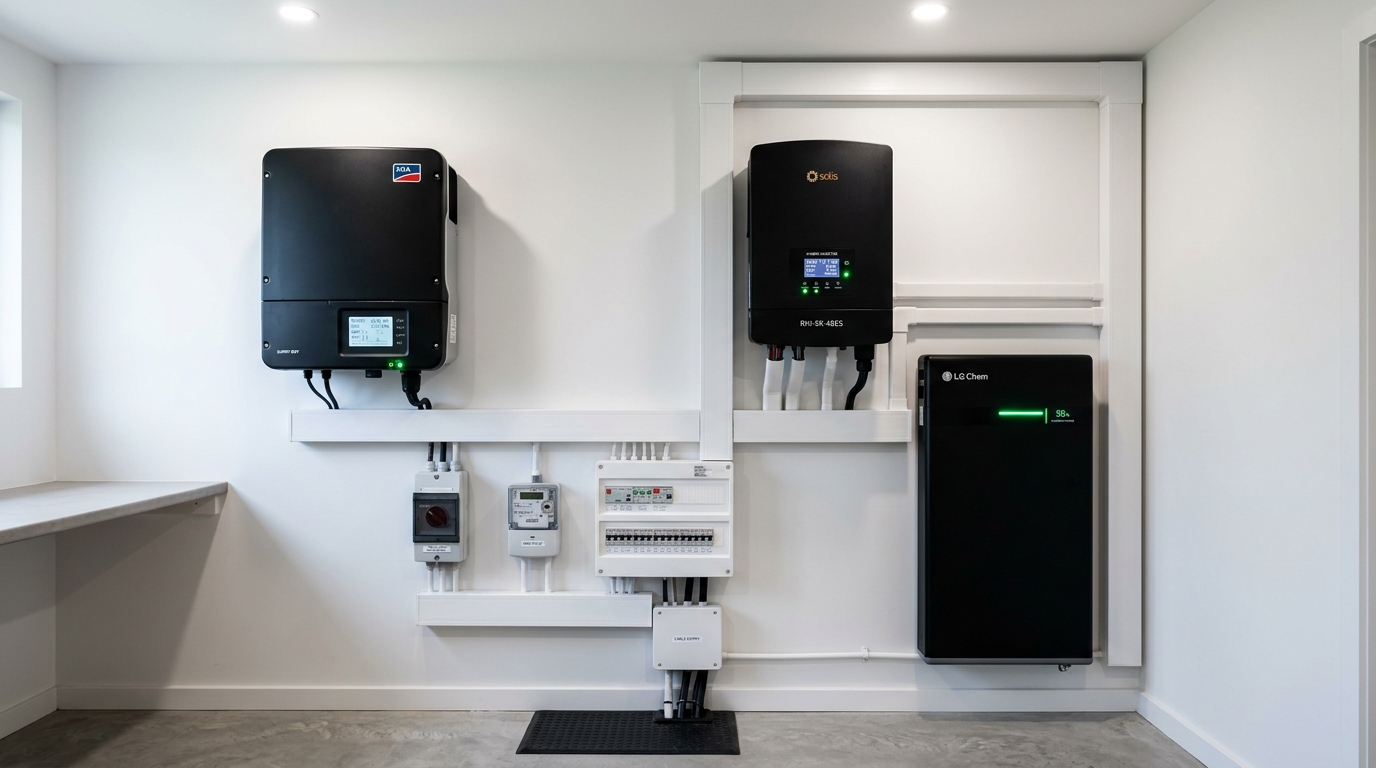
Option 1: On-Grid (Grid-Tied) Inverter — The Most Popular Choice
On-Grid inverters are installed in over 90% of residential rooftop systems in Indian cities today. They are connected directly to your local electricity board's power grid (BESCOM, Tata Power, MSEDCL, BSES, UPPCL, etc.) via a two-way bi-directional Net Meter.
How It Works During the Day:
- In the daytime, your solar panels generate electricity. Your home uses this solar power first.
- If your solar panels are producing 3 kW but your home only needs 1 kW, the extra 2 kW is automatically exported into the city grid. Your electricity net-meter literally runs backwards, earning you credits!
- At night, when the sun goes down, you automatically draw power from the grid like normal. At the end of the month, you only pay for the "net" difference.
The Crucial Limitation: Anti-Islanding Protection
Many homeowners are surprised to learn this rule: If the city electricity grid has a power outage, an on-grid solar inverter will immediately shut down, even on a bright sunny afternoon!
Why does this happen? This is an international safety feature called Anti-Islanding. If electricity lines in your neighborhood go down, linemen work on the wires to fix the fault. If your rooftop panels continued pumping electricity into the grid lines, the workers would be electrocuted. Therefore, on-grid inverters shut down within milliseconds of a grid failure.
Best For: Cities and suburban areas where power cuts are rare (less than 15–30 minutes a week). On-grid inverters are the cheapest, require zero battery maintenance, have the fastest financial payback (3 to 4 years), and qualify 100% for the ₹78,000 PM Surya Ghar subsidy.
Option 2: Hybrid Inverters — Solar Plus Battery Backup
A Hybrid Inverter combines the best of both worlds: it supports net metering to lower your electricity bill AND connects to modern lithium-ion batteries (LiFePO4) to provide backup power during load shedding.
How It Works:
- During the day, solar powers your home first.
- Excess solar electricity charges your home battery bank.
- Once the battery is 100% full, any remaining extra solar is exported to the grid for net-metering credits.
- When a power cut occurs, the hybrid inverter switches into backup mode in less than 20 milliseconds (so your Wi-Fi, computers, and TV don't even reboot!) and runs your home from the battery.
The Cost Factor: A hybrid inverter and 5 kWh lithium battery bank adds ₹1.2 lakh to ₹2.0 lakh to the initial cost of your system. (Important note: The government subsidy applies to the solar capacity, but not to the battery portion).
Best For: Tier-2 and tier-3 cities, rural areas, or independent villas where power outages occur frequently.
Option 3: Microinverters — The Premium Rooftop Solution
In standard on-grid or hybrid installations, all panels are wired together in a "string" leading to one large inverter box mounted on your wall (known as a String Inverter). If one panel in the string is covered by bird droppings or tree shade, the output of the whole string drops.
Microinverters take a different approach: tiny, waterproof inverters (about the size of a paperback book) are mounted directly behind each individual solar plate on your roof.
Advantages of Microinverters:
- Independent Generation: Every single panel operates on its own. A shadow on Panel #1 has zero impact on Panel #2.
- No High Voltage DC Wiring: DC power is converted to AC right at the panel, eliminating high-voltage DC fire risks on your roof.
- 25-Year Warranty: Leading microinverter brands like Enphase offer 25-year warranties matching the lifespan of the panels.
The Drawback: Microinverters cost 30% to 50% more than standard string inverters.
Decision Matrix: Which Inverter Fits Your Needs?
| Inverter Type | Power Cut Backup? | Net Metering? | Payback Period | Best Suited For |
|---|---|---|---|---|
| On-Grid (String) | No (Shuts down) | Yes (Full Credits) | 3 to 4 Years | 90% of urban homes with reliable power grid |
| Hybrid (With Battery) | Yes (Full Home Backup) | Yes (Full Credits) | 5 to 7 Years | Areas with frequent power cuts or load shedding |
| Microinverter | Optional with Envoy | Yes (Full Credits) | 5 to 6 Years | Roofs with complex shading or multiple angles |
Top Inverter Brands in India & What Warranty to Demand
When selecting your inverter brand, stick with reputable tier-1 manufacturers with established Indian service centers:
- On-Grid String Inverters: Sungrow, Growatt, Solis, GoodWe, Havells, Polycab. Demand a minimum 5-year replacement warranty (many brands now offer 7 to 10-year warranty options).
- Microinverters: Enphase (25-year warranty).
- Dual MPPT Tracker: If your panels are facing two different directions (e.g., East and South), ensure your inverter has Dual MPPT inputs so each roof section is optimized independently.